The more government has control over a country's resources, the more its citizens look to it for help. The more a country's citizens look to government for help, the more that government can command yet greater control of its citizens resources. In 1969, the U.S. government controlled about 30 percent of annual U.S. economic output (gross domestic product--GDP). In 2010, the U.S. government controlled over 40 percent of annual GDP. Most of this increase consisted of government transfer payments (i.e., government payouts to individuals and households). Thus, in 2011, far more U.S. citizen's than ever are looking to government for help.
Socialism can be loosely (but not unreasonably) defined as government control of a nation's resources. So if you are wondering in what direction this country is heading and how fast, well you do the math.
As for the future of the U.S. economy, this blog has cited numerous studies documenting the inverse relationship between the size of government and the economy.
Thursday, July 21, 2011


Friday, July 15, 2011
REGARDING THE DEBT LIMIT
"I wish it were possible to obtain a single amendment to our Constitution. I would be willing to depend on that alone for the reduction of the administration of our government; I mean an additional article taking from the Federal Government the power of borrowing."
Thomas Jefferson--1798
Thursday, July 7, 2011
THE FUTURE OF THE US ECONOMY
As the man says in this video, everyone has to hear this (3 min.) message. Brace yourself.
http://www.youtube.com/embed/VtVbUmcQSuk
http://www.youtube.com/embed/VtVbUmcQSuk
Wednesday, July 6, 2011
GOVERNMENT AT WORK
Almost two thirds of government spending amounts to no more than taking money from one person and giving it to another. In 1960, this type of activity accounted for only about 30 percent of government spending, now it's over 60%--see below. The blue line depicts government transfer payments as a percent of government spending.


Friday, July 1, 2011
MORE ON THE PROPROSED SPENDING "CUTS"
$2 Trillion in Cuts in Perspective
Congressional Republicans have said that spending cuts must be at least as large as an increase in the debt ceiling. Negotiations over lifting the debt ceiling are ongoing, but the “magic number,” so-to-speak, would be around $2 trillion in spending cuts.
Cutting $2 trillion in federal spending sounds like a lot, but it’s actually relatively small because the cuts would likely occur over ten years. According to the Congressional Budget Office’s most recent budget baseline, the federal government will spend almost $46 trillion over the next ten years.
The following chart shows what $2 trillion in spending cuts over the next ten years looks like when measured against the CBO’s baseline. Even with the cuts, federal spending would still increase by $1.8 trillion:

Rather than actually cutting spending, federal spending (and debt) would continue to grow – just at a slightly lower rate. And as Chris Edwards continues to warn, there is a strong possibility that some or all of the “cuts” could be phony.
Congressional Republicans have said that spending cuts must be at least as large as an increase in the debt ceiling. Negotiations over lifting the debt ceiling are ongoing, but the “magic number,” so-to-speak, would be around $2 trillion in spending cuts.
Cutting $2 trillion in federal spending sounds like a lot, but it’s actually relatively small because the cuts would likely occur over ten years. According to the Congressional Budget Office’s most recent budget baseline, the federal government will spend almost $46 trillion over the next ten years.
The following chart shows what $2 trillion in spending cuts over the next ten years looks like when measured against the CBO’s baseline. Even with the cuts, federal spending would still increase by $1.8 trillion:

THE UNBELIEVABLE DEPTH OF OUR SPENDING PROBLEM
This is a repeat of a previous post--but it bears repeating. PLEASE watch the video.
http://wimp.com/budgetcuts/
http://wimp.com/budgetcuts/
Friday, June 24, 2011
MORE ON: GOVERNMENT CAN'T CREATE JOBS
This from an article in Politico:
Some policymakers are now looking at expanding job training and other federal employment programs. Even conservative House Budget Committee ChairmanPaul Ryan (R-Wis.) proposed to “strengthen” these programs in his recent fiscal plan. Alas, the history of waste and failure in these programs argues for termination, not expansion.
Federal programs for unemployed and disadvantaged workers now cost $18 billion a year, yet the Government Accountability Office recently concluded that “little is known about the effectiveness of employment and training programs we identified.” Indeed, many studies over the decades have found that these programs — though well intentioned — don’t help the economy much, if at all.
DWD--The above actually doesn't go far enough. There is considerable evidence that government job programs actually "create" a net loss in jobs!
Some policymakers are now looking at expanding job training and other federal employment programs. Even conservative House Budget Committee ChairmanPaul Ryan (R-Wis.) proposed to “strengthen” these programs in his recent fiscal plan. Alas, the history of waste and failure in these programs argues for termination, not expansion.
Federal programs for unemployed and disadvantaged workers now cost $18 billion a year, yet the Government Accountability Office recently concluded that “little is known about the effectiveness of employment and training programs we identified.” Indeed, many studies over the decades have found that these programs — though well intentioned — don’t help the economy much, if at all.
DWD--The above actually doesn't go far enough. There is considerable evidence that government job programs actually "create" a net loss in jobs!
Thursday, June 16, 2011
GOVERNMENT TO THE RESCUE?
Robert Lucas of the University of Chicago offers a couple of telling graphs. This first chart shows the history of U.S. economic growth over the past 140 years. As you can see, the growth rate was remarkably constant over time, and there were always periods of rapid growth following economic downturns.

Lucas, who won the Nobel Prize in economics in 1995, then looks at the data for the recent downturn and recovery. As you can see, we have been struggling to get back to average growth rates and we have not enjoyed any of the above-average growth that normally follows a recession.

The key question, of course, is why growth has been anemic, resulting in (what seems to be) a permanent loss of output. In his presentation, Lucas warns that bad government policy is playing a big role. He says that “the problem is government is doing too much,” and he specifically highlights the “likelihood of much higher taxes, focused on ‘the rich’” and a “large increase in the role of government” in the healthcare sector.
In his conclusion, Professor Lucas is not overly optimistic about recovering lost output. He doesn’t make any flamboyant claims, but he does note that “European economies have larger government role and 20-30% lower income level than US.”
The obvious connection is that America is becoming a European-style welfare state and it is unavoidable that we will suffer from European-style economic malaise.
To those of you who would like to see a more healthy economic recovery: please don't ask the government to help.
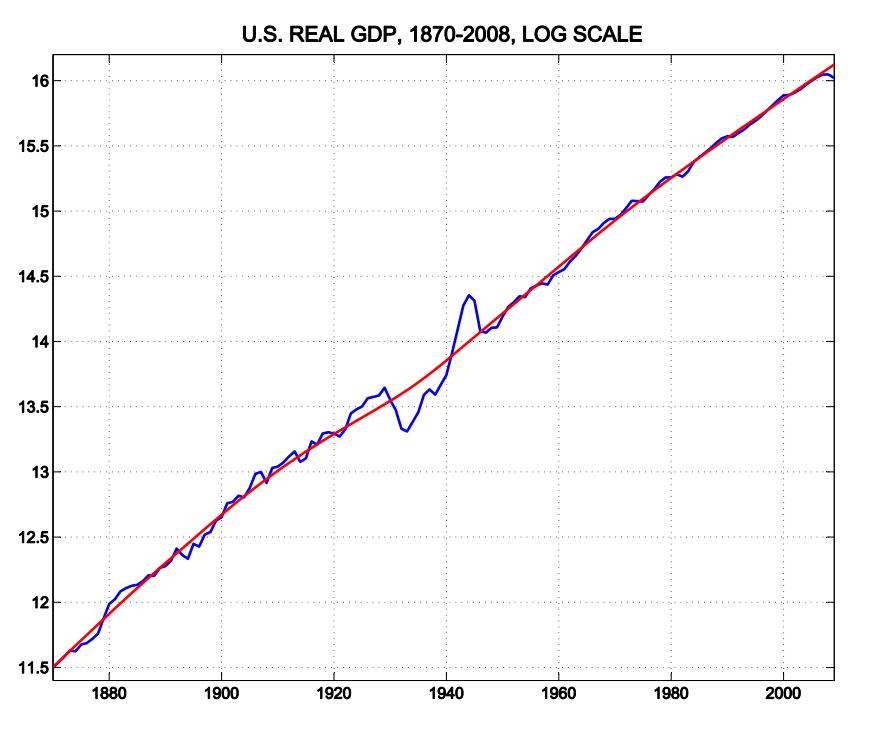
Lucas, who won the Nobel Prize in economics in 1995, then looks at the data for the recent downturn and recovery. As you can see, we have been struggling to get back to average growth rates and we have not enjoyed any of the above-average growth that normally follows a recession.

The key question, of course, is why growth has been anemic, resulting in (what seems to be) a permanent loss of output. In his presentation, Lucas warns that bad government policy is playing a big role. He says that “the problem is government is doing too much,” and he specifically highlights the “likelihood of much higher taxes, focused on ‘the rich’” and a “large increase in the role of government” in the healthcare sector.
In his conclusion, Professor Lucas is not overly optimistic about recovering lost output. He doesn’t make any flamboyant claims, but he does note that “European economies have larger government role and 20-30% lower income level than US.”
The obvious connection is that America is becoming a European-style welfare state and it is unavoidable that we will suffer from European-style economic malaise.
To those of you who would like to see a more healthy economic recovery: please don't ask the government to help.
Wednesday, June 15, 2011
US CITIZENS ARE POLITICALLY DOUBLE-MINDED
If you're interested, please click on "WHO'S ON FIRST?" found in the right margin of this page.
Thank you,
DWD
Thank you,
DWD
Monday, June 6, 2011
WORDS OF WISDOM FROM ABE LINCOLN AND OTHERS
“You cannot help the poor by destroying the rich.
You cannot strengthen the weak by weakening the strong.
You cannot bring about prosperity by discouraging thrift.
You cannot lift the wage earner up by pulling the wage payer down.
You cannot further the brotherhood of man by inciting class hatred.
You cannot build character and courage by taking away peoples initiative and independence.
You cannot help people permanently by doing for them what they could and should do for themselves.” -- Abraham Lincoln
And finally,
"The budget should be balanced, the Treasury should be refilled, public debt should be reduced, the arrogance of officialdom should be tempered and controlled, and the assistance to foreign lands should be curtailed lestRome Cicero
You cannot strengthen the weak by weakening the strong.
You cannot bring about prosperity by discouraging thrift.
You cannot lift the wage earner up by pulling the wage payer down.
You cannot further the brotherhood of man by inciting class hatred.
You cannot build character and courage by taking away peoples initiative and independence.
You cannot help people permanently by doing for them what they could and should do for themselves.” -- Abraham Lincoln
“America
The founding fathers preferred a Republican form of government over a simple democracy. As Thomas Jefferson said, “A democracy is nothing more than mob rule, where 51 percent of the people may take away the rights of the other 49.”
Here is the end result of democracies — “A democracy will continue to exist up until the time that voters discover that they can vote themselves generous gifts from the public treasury. From that moment on, the majority always votes for the candidates who promise the most benefits from the public treasury, with the result that every democracy will finally collapse due to loose fical policy.” – Alexander Tyler, 1787 (Scottish history professor)
And finally,
"The budget should be balanced, the Treasury should be refilled, public debt should be reduced, the arrogance of officialdom should be tempered and controlled, and the assistance to foreign lands should be curtailed lest
Friday, June 3, 2011
ADAM SMITH ON GOVERNMENT AND TAXES
Writing in the mid- to late-1700's, Adam Smith penned the following:
“The agents of [government] regard the wealth of their master {i.e., we the people} as inexhaustible; are careless at what price they buy; are careless at what price they sell.”
“The agents of [government] regard the wealth of their master {i.e., we the people} as inexhaustible; are careless at what price they buy; are careless at what price they sell.”
“Those unproductive hands...may consume so great a share...that all the frugality and good conduct of individuals may not be able to compensate...this violent and forced encroachment.”
“After all the proper subjects of taxation have been exhausted, if the exigencies of the state still continue to require new taxes, they must be imposed on improper ones.”
“The statesman who should attempt to direct private people in what manner they ought to employ their capitals, would...assume an authority which could safely be trusted, not only to no single person, but to no council or senate whatever, and which would nowhere be so dangerous as in the hands of a man who had folly and presumption enough to fancy himself fit to exercise it.”
Thursday, May 26, 2011
GOVERNMENT AND JOBS
As I have argued before, government cannot create jobs (on net). Government actions are much more likely to destroy jobs (see editorial "Government Cannot Create Jobs" in right margin of this page). The following is a real world example of how government is a systematic destroyer of jobs, as described by an annomous business executive. I would argue that this is not an isolated case but is a common circumstance.
In any case, our pieces of equipment (let's call them tractors) use expensive components (let's call them engines) made and sold by Americans. The engines are used by American workers in multiple states and they make more energy available for Americans. That fact alone attracts the ire of some. But the fact that our service is very valuable and produces large profits makes the industry and the service an irresistible target.
This year, I learned that one agency of the federal government has created and is enforcing rules that strictly limit the types and numbers of engines we can buy to make our tractors. They limit how many of each type of engine we can buy in a year, and they limit the grand total we can buy. This is offensive for many reasons — not the least of which is that we would hire more people if we were allowed to make more tractors.
I could make an endless list of the unseen and damaging effects of their nonsense. But here is a short list:
"In fact, I have witnessed the loss of jobs as a direct result of regulations by unnamed and unelected bureaucrats, who are backed up by threats of prosecution from the government. Our government is stifling job creation.
Although I am not a conspiracy theorist, I am certain that if I wrote about my experience with specifics, the company for which I work would suffer retribution by our government. I do not have the right to put them in jeopardy. And if the legal department of my employer knew I was writing this, they would "lose it." For these reasons, I feel it necessary to write anonymously and with some imprecision.
This fear of retribution, in and of itself, is a powerful statement about the sad conditions in which we live and do business in the United States
My employer makes very expensive pieces of equipment for use in an industry that has itself sustained undeserved attacks by our government and by unscrupulous so-called environmentalists.[1]In any case, our pieces of equipment (let's call them tractors) use expensive components (let's call them engines) made and sold by Americans. The engines are used by American workers in multiple states and they make more energy available for Americans. That fact alone attracts the ire of some. But the fact that our service is very valuable and produces large profits makes the industry and the service an irresistible target.
This year, I learned that one agency of the federal government has created and is enforcing rules that strictly limit the types and numbers of engines we can buy to make our tractors. They limit how many of each type of engine we can buy in a year, and they limit the grand total we can buy. This is offensive for many reasons — not the least of which is that we would hire more people if we were allowed to make more tractors.
I could make an endless list of the unseen and damaging effects of their nonsense. But here is a short list:
1. Without these rules, we would hire more welders, assemblers, and accountants. This would result in the improvement of our local economy, because the new employees and their families would all need food, clothing, housing, entertainment, etc.
2. To keep up with our increased demand for the tractor engines we need, the engine manufacturers, their employees, and their families would benefit.
3. The companies to which we sell tractors would hire more operators. Their families and the places they shop at would benefit.
4. The companies who request our product would become more profitable, resulting in expansions, bonuses, etc.
5. And, last (and totally forgotten) are the American citizens. Each and every citizen would benefit from the larger supply of energy and the resultant lower prices.
Some people might say that it is good to limit the numbers of these engines in order to protect the environment. But that argument only holds water long enough for a ten-second sound bite. The reality is that this destructive government agency also has rules that permit smaller versions of the same engines. What that means is that we would be permitted to create 50 tractors using the (approved) smaller engines instead of 20 using the larger ones. It is true that the larger engine pollutes more than the smaller one. But using the smaller engines would require more tractors to be built and more fuel to bring them to the job sites. In other words, using fewer tractors with the larger (evil) engines produces fewer net emissions than more tractors with the smaller (approved) engines would.
So, who is causing all this, and why are they doing it? You can answer that question for yourself by discovering who benefits from the regulations. The list includes the politicians who use these issues to their advantage regardless of the truth. It includes the government bureaucrats who want more power to justify their own salaries and positions. It also includes reporters who can't wait for the next "breaking news" about an "environmental threat," or "dire emergency." And it includes university professors and other academic elites who come in to petition for huge government grants and to get paid to speak as "experts." The dark irony is that all these supposed protectors are really engaging in a self-serving round robin of deceit.
The truth is they are horrifically destructive to the prosperity and well-being of all Americans. But because their public faces hide the despicable truth, they have been able to get away with it. Our only hope is to get these people out of business — literally and figuratively. I've got to be honest, though. It won't be easy. They are fighting for their livelihoods, too."
Monday, May 9, 2011
GOVERNMENT TO THE RESCUE
After spending trillions of tax payer dollars to "stimulate" the economy, this is how Obama's economic plan panned out compared to what he said would happen. Maybe he and his experts aren't as smart as they claim. (The blue line shows Obama's projections--the dots are what actually happened.)


Thursday, April 28, 2011
THE GAS PRICE CONUMDRUM
Recently, we have experienced another jump in gasoline prices causing outcries among consumers and prompting debates as to what ought to be done about the situation. These outcries and debates beg two questions: How “high” are gas prices? What, if anything, can be done about it?
To read further, check out my editorial with this title found on the right margin of the screen.
To read further, check out my editorial with this title found on the right margin of the screen.
Tuesday, April 26, 2011
THE VIRTUES OF SCHOOL CHOISE
Besides the obvious one--freedom of choise--not to mention lower cost, the virtues of increasing educational choise by enabling private schools to compete for students on a fair basis with public schools are many. This from the Cato Institute:

Call me old fashioned, but I prefer to reach policy conclusions based on empirical research. So after comparing the performance of alternative school systems over the past 2,000 years, I surveyed the modern econometric literature on the subject for the Journal of School Choice. What I found is that the freest, most market-like education systems consistently outperform the sorts of state monopolies preferred by Ms. Weingarten and her fellow travelers. Appended below is the chart counting up how many studies favored education markets over state school monopolies, and vice-versa, in each of six outcome areas.
If Ms. Weingarten is aware of a similar weight of scientific evidence favoring her position, she should present it. Otherwise, why would anyone bother to heed her? More puzzling still, what was it about her alleged-dog-allegedly-bites-man op-ed that the WSJ thought worth publishing?

Subscribe to:
Posts (Atom)